
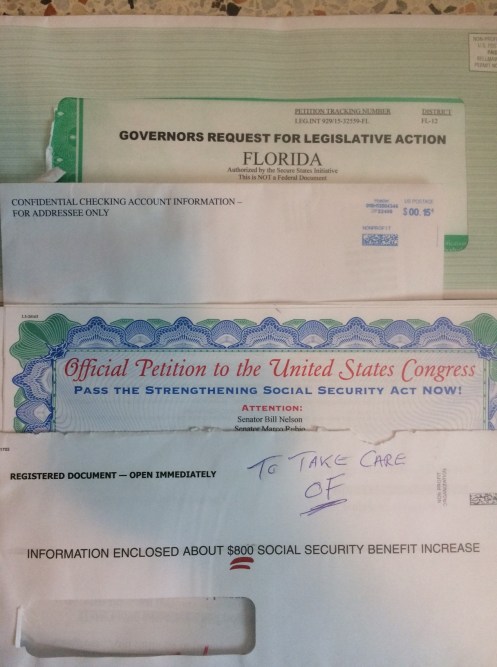
 PLEASE! PLEASE! PLEASE! Stop mailing your misleading SH*T to my 85-year old dad!
Last week I bagged up (for disposal) six 30 gallon garbage bags of junk mail. I spent a couple of hours sorting through the mail my dad had accumulated because it was just too overwhelming for him to sort with any kind of speed. Why is my 85-year old father having trouble sorting this mail?
First, my dad comes from a time when snail mail meant something. If something came in the mail it was usually important. Sure, there were solicitations and “junk mail” back in the day, but they were typically more obvious and less overwhelmingly abundant. I’ve been at my dad’s house when the mail arrives and there are days when it does not fit in his mailbox–the mailman leaves it in a bin by his door.
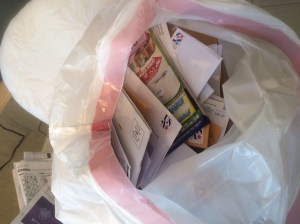 Just a couple of days ago I was at my dad’s when the mail arrived. I went through the more than 60 envelopes with him. There was not a single piece of “legitimate” mail–a bill, a statement or other official documents. But there were plenty of solicitations, pleas and “gifts”–“gifts” that were “thank you’s” for the numerous small donations they had already scammed out of my trusting father with their manipulative tactics.
To call most of this mail is misleading would be a gross understatement. I’ve noticed several “tactics” that are being used.
- Blank Envelopes: If there is no indication of who it is from or what it’s about, of course you need to open it, right?
- Official-Looking Packaging
- “Urgent” Packaging
- Official-Sounding Text/Language
- “Confidential Checking Account Information Enclosed”
- “For Addressee Only”
- No Return Address/No Name of the Organization
- “Handwritten” Pleas
- Any combination of the above


In addition to these basics that you may see in your own junk mail, these criminals use particularly heinous methods to scare and manipulate the elderly. They use misleading and inflammatory language on topics relevant to seniors in their mailings:
- Social Security
- Medicare
- Retirement Benefits
Instead of actually helping–protecting the rights of seniors and their limited incomes–these leeches are bleeding away the elderly’s finances one $5, $10, $20 or $25 check at a time.
 If you have an elderly parent (or grandparent), I highly suggest you start examining and talking to them about their mail–NOW. If they are receiving more than 10 pieces of junk mail a day–take a closer look. If they are starting to experience any type of (even mild) memory or cognitive issues, take an even closer look–and, find a way to examine their checkbook to see if they might be succumbing to the manipulative pleas and actually writing checks to these criminals.
The elderly often think that their donations to these organizations are tax-deductible contributions going to “charities”–but many are 501(c)(4) organizations (not 501(c)(3))and the contributions ARE NOT tax-deductible. Of course, you only see that if you can read past all the inflammatory language and make your way to the very fine print inconveniently located in just one place on their materials.
There is a blog I found specific to junk mail: ARE YOU DROWNING IN JUNK MAIL? I’ve found it useful–particularly as I go through my dad’s mail and try to get him off mailing lists one organization at a time. It has links to many of these junk mail offenders.
What these organizations are doing may or may not be illegal, but rest assured it is unethical and immoral. I encourage everyone to engage their parents, grandparents and legislators in this discussion and help end this travesty of elder abuse.
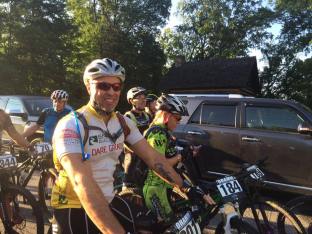

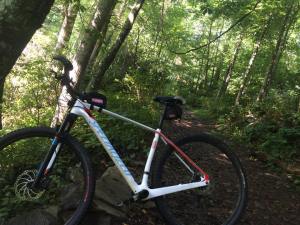 Gear. My bike (Specialized Stump Jumper) performed well. No complaints with my bike. But, the soles of my shoes delaminated (maybe from all the walking?) just before the main Heartbreak Ridge downhill in the last third of the race. They were my (old) back-up shoes–used mainly because I couldn’t bring myself to drop the cash on a new pair of mountain bike shoes. I ended up zip-tying them (with mixed results) until I encountered a race medic who wrapped them generously with athletic tape. Of course, I’ve invested in a new pair of shoes since then.
 My cats and I have different interpretations of the words “a lot” and “frequently.” To Harpo, Lolie and Darryl (when referring to how often they would like to be fed wet food) “frequently” likely means three times a day (or more). In my mind, “frequently” is once a day. Likewise, I think “a lot” of catnip is about a half teaspoon sprinkled on a toy–for them, it’s an entire eight ounce container they can romp through.
 People have similarly different interpretations of what are called “indefinite numbers”–words like “several,” “many,” “most” “frequently” and “few;” or, even more informal terms like “oodles,” “a smidge,” “tons” or “a lot.” “Several” or “many” might refer to “more than 10” or “or more than 100” or “more than a million’ depending on the context and/or the individual. “Most agree” might mean, to you, that 90% agree, while to me it might mean that 51% or more agree–there is a difference in that perception. Why does this matter?
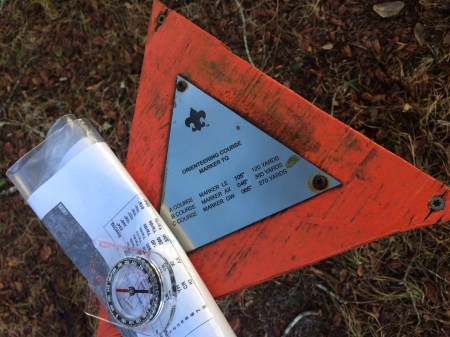 Luckily, I was running at Starkey Wilderness Park in Pasco County and I happened to start and finish my run adjacent to an old Eagle Scout Project–a permanent orienteering course. I had printed off the course instructions a while ago and put them in my Starkey file–which I happened to have with me as I was also at the park for an event meeting. I pulled out the instructions, looked at the time and figured I had time to do the one mile course prior to my meeting.
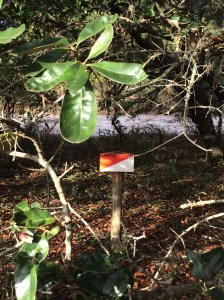 I grabbed my compass, stuck the instructions in a Ziploc bag, strapped on my water belt and dashed off into the woods. It’s a bearing/distance-type of orienteering course, so I was dialing the bearing in on my compass and then dashing off along that course while counting my “paces.” It was a series of sprints and stops cross country–easy ground and rough ground, under trees and through tall grass–all while sporting a face-stretching smile.
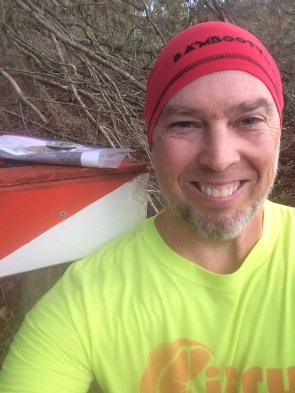 It was just what I needed to help reinvigorate my running and start my day off full of positive mental energy. And, in the back of my mind I was creating future running workouts that will also incorporate that orienteering course.
 Even before this past year’s presidential election (and the focus it brought to the topic), I noticed it was becoming more difficult for some people to distinguish between “real news” and “fake news.” And, of course, we’ve even been told that “there are no such things as facts.”
 On a recent trip back from a race in Miami, one of the outrigger team guys I was driving with shouted “Old School!” and pointed out a car in which the passenger had a paper map unfolded in their lap. It’s a rare sight in a world where our cars and phones are equipped with GPS devices that will map routes, find us a Starbucks and even talk us through the directions.
 Second, I just love maps. I have to thank my dad, and his National Geographic Magazine subscription, for originally stoking my love of maps. Add to that years of backpacking, hiking and adventure racing–poring over topographic and trail maps–and I find it difficult to not pause and look at any map I come across.
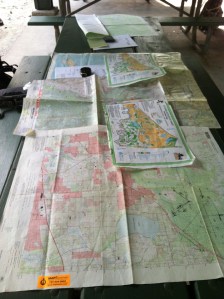 Over the last 12 years or so, I’ve taken my love of maps and land navigation and taught hundreds of people the skills they need to find their way in the woods. Every once in awhile, when I post an upcoming course, I get a questioning comment like “Why would anyone need this anymore? Use a GPS. Use your phone.” Or now, “There’s an app for that.”
 In my navigation clinics, I emphasize map reading, terrain recognition and environmental awareness. Map reading involves developing a comfort level with a variety of common map types, map symbols, map scales, topographic lines and colors. Terrain recognition involves looking at a feature (e.g. a hill, a river, a road or a particular habitat) in nature and locating it on a map (and vice versa). Environmental awareness is possibly the toughest skill to master–challenging because we may be trying to move quickly (driving, running or mountain biking) while also paying attention to the map, road, other drivers, our footing, other bikers or trail obstacles. But, efficient land navigation (sans GPS) requires an almost constant awareness of features behind, around and ahead of you.
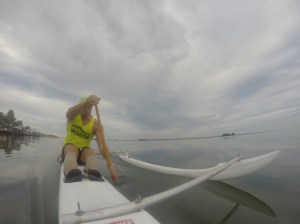 Two weeks ago I was on the water north of the Dunedin Causeway paddling my OC1 (a one-person outrigger canoe). Tucking in close to shore, I was trying to avoid the wind and just grind away at a longer, flat water workout. As I came around a long marina dock, I noticed a thin, older man paddling steadily with a kayak paddle in a recreational canoe .
 I’m sure it was a combination of both–but, I like to think the conversation was the critical factor. Paddlers are passionate folk and the encounter helped remind my how much I love sharing my own experiences and hearing about those of others. It also reminded me of how energizing it can also be to just stop and notice–not just the dolphins and the manatees, but the cloud reflections on the surface, the sea grass bent in the current or the subtle changes in light and color as the dawn progresses.
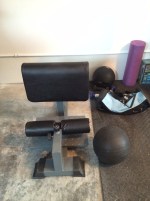 The two-weeks prior to an event are almost always a struggle for me–a struggle to balance workouts with the last minute preparations for producing an event for over 800 participants. And, being the type that loves long, grinding workouts, that becomes quite a challenge.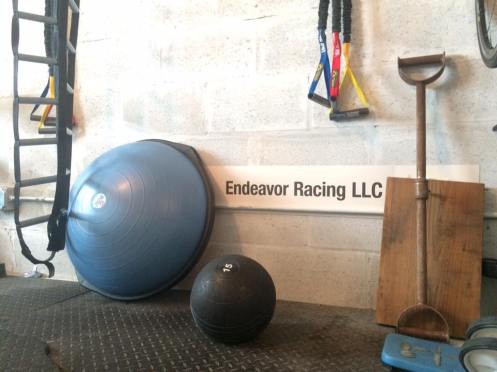
 Kip Koelsch Author